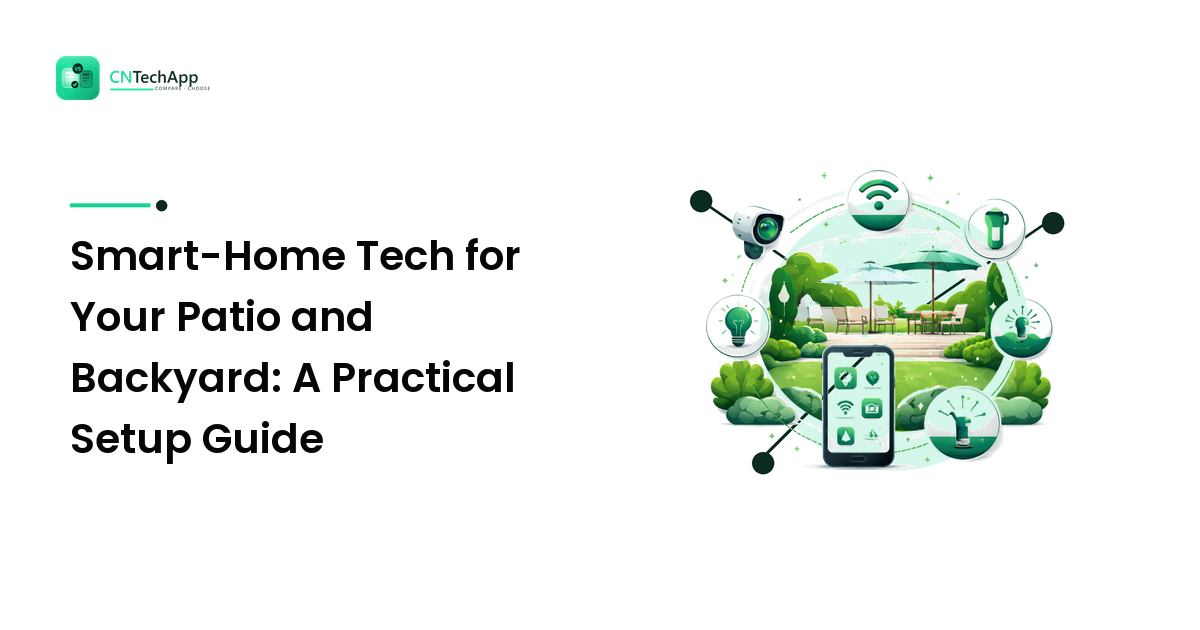
The smart-home features people love indoors — lights that come on by themselves, cameras you can check from your phone, a thermostat that just handles it — all have outdoor cousins now. The problem is that a backyard is a harder place for technology than a living room. There is weather, distance from the router, and nowhere tidy to hide a cable. Bolt a smart camera to a fence post without a plan and you get a dead battery, a spotty signal, and wires draped across the patio.
The takeaway up front: outdoor smart-home tech works beautifully, but only when three unglamorous things are handled first — a signal that actually reaches, a way to get power there, and a surface underneath that you can build on and maintain. Get those right and the gadgets are the easy part. This guide walks through the tech worth adding to a patio or backyard, and the groundwork that makes each piece actually last.
Start with the thing everything depends on: outdoor Wi-Fi
Almost every outdoor smart device — cameras, doorbells, speakers, irrigation controllers — needs a stable connection, and your indoor router usually gives up somewhere around the back wall of the house. Before buying anything, walk the yard with your phone and check the signal where each device will live.
If it drops off, you have two good options. A mesh Wi-Fi node placed in a back room or a weatherproof outdoor unit extends coverage into the yard, and most mesh systems add a node in a few taps. For a detached patio, shed, or ADU, a wired connection out to an access point is more reliable than anything wireless. Either way, treat coverage as step one — and while you are in the router's settings, it is worth putting outdoor cameras and cheap smart plugs on a separate network. Our guide to securing your home Wi-Fi router explains why a guest network for the least-trusted devices keeps a compromised outdoor gadget away from your laptop and phone.
Smart lighting that makes the space usable after dark
Outdoor lighting is the single upgrade that changes how much you actually use a patio, and it is where smart control earns its keep. Instead of one harsh floodlight, you can layer:
- Path and step lights on a schedule or sunset trigger, so walkways light themselves as it gets dark.
- String or accent lights on a smart plug or switch, dimmable from your phone or a voice assistant.
- Motion-activated security lighting near gates and side yards that only comes on when something moves.
Two practical notes. Choose fixtures rated for outdoor use (look for an IP65 rating or higher for anything exposed to rain), and think about power before you buy. Low-voltage lighting needs a transformer and cable runs; solar avoids wiring but underperforms in shade and winter. The cleanest installs plan those cable routes into the hardscape rather than stapling them along a fence afterward.
Cameras and a video doorbell, placed once and done
A weatherproof camera covering the yard and a doorbell at the gate cover most people's needs. The mistakes are almost always about placement and power, not the camera itself: mount high enough to be out of reach, angle away from direct sun and porch lights that blind the sensor, and decide up front between battery (easy, but you will be recharging) and wired (more work now, forgotten forever after). Running low-voltage camera wiring is far simpler when there are conduit paths under a patio or along a walkway instead of a scramble to hide cable across finished surfaces.
Smart irrigation, which pays for itself
If you keep any planting beds, a smart irrigation controller is one of the highest-value outdoor upgrades. It swaps a dumb timer for a system that skips watering when rain is forecast and adjusts to the season, which genuinely cuts water bills — a real consideration in drought-prone regions like California. Many homeowners pair it with a move away from thirsty lawn toward artificial turf for the areas that just need to look green and take foot traffic, cutting both the watering and the mowing to near zero.
The part people skip: the surface underneath
Here is what ties all of this together and rarely gets mentioned in gadget reviews. Every outdoor device needs mounting, power, and a route for wiring — and the patio, walkway, or yard surface decides how clean and durable that install is. This is where the groundwork matters more than the gadgets.
Interlocking pavers are a genuinely tech-friendly surface: unlike a poured concrete slab, individual pavers lift out, so lighting cable, low-voltage conduit, or a repair can be reached later and the surface put right back — no jackhammer, no patchwork. A properly graded patio also gives outdoor speakers, heaters, and furniture a stable, level home. And artificial turf turns the "green" part of a smart yard into something that needs no irrigation zone and no mower on a schedule to fight with.
For readers in the Bay Area planning this kind of space, a hardscaping specialist like Pavers and Turf by O'Neill's is worth a look while you are still in the planning stage — the reason being simple: a landscaper who installs interlocking pavers, patios, walkways, and artificial turf can build the conduit runs, level surfaces, and low-maintenance zones your tech needs into the project, instead of you retrofitting around finished concrete a year later. Getting the surface and the wiring paths designed together is what separates a clean smart yard from a tangle of extension cords.
FAQ
Do I need to run power to the yard for all this?
Not always. Solar path lights, battery cameras, and Wi-Fi controllers avoid new wiring, but they trade convenience for recharging and weaker cold-weather performance. For anything you want to install once and forget, plan a low-voltage power and conduit route — far easier to do while a patio is being built than after.
Will my home Wi-Fi reach the backyard?
Often not past the back wall. Test with your phone first, then add a mesh node or a wired outdoor access point. Put outdoor and budget smart devices on a separate guest network so a weak one cannot reach your main computers.
Is artificial turf worth it for a tech-focused yard?
For low-maintenance green space that pairs with smart irrigation elsewhere, many homeowners find it worthwhile: no watering zone, no mowing schedule, and a stable, level surface. It suits water-conscious regions and high-traffic areas that struggle to keep real grass alive.
Why do pavers matter for outdoor tech?
Because they lift out. Individual pavers give you access to buried lighting cable and conduit later without breaking up a concrete slab, which makes repairs and additions far cleaner over the life of the yard.
The bottom line
Outdoor smart-home tech is genuinely good now, but the gadgets are the last 10 percent. The signal has to reach, the power has to get there, and the surface underneath has to be something you can build on and maintain. Plan those three first — ideally while the patio or yard itself is being designed — and every camera, light, and controller you add afterward goes in cleanly and stays working. If you are in the Bay Area and starting from a blank slate, getting the hardscaping and low-maintenance turf right with a specialist like Pavers and Turf by O'Neill's is the groundwork that makes the smart part easy.